AVERY
A Vision from the ARDEN Lab
ARDEN proves the model in the country. AVERY brings it to the city. A complete circular food ecosystem compressed into the third dimension — the same system ARDEN runs across 300 acres, brought into a single building.
This is research, not a current commitment. AVERY represents genuine intellectual ambition — commercially grounded, but positioned where a pharmaceutical company positions its R&D pipeline.
The proof starts here. The city comes next.
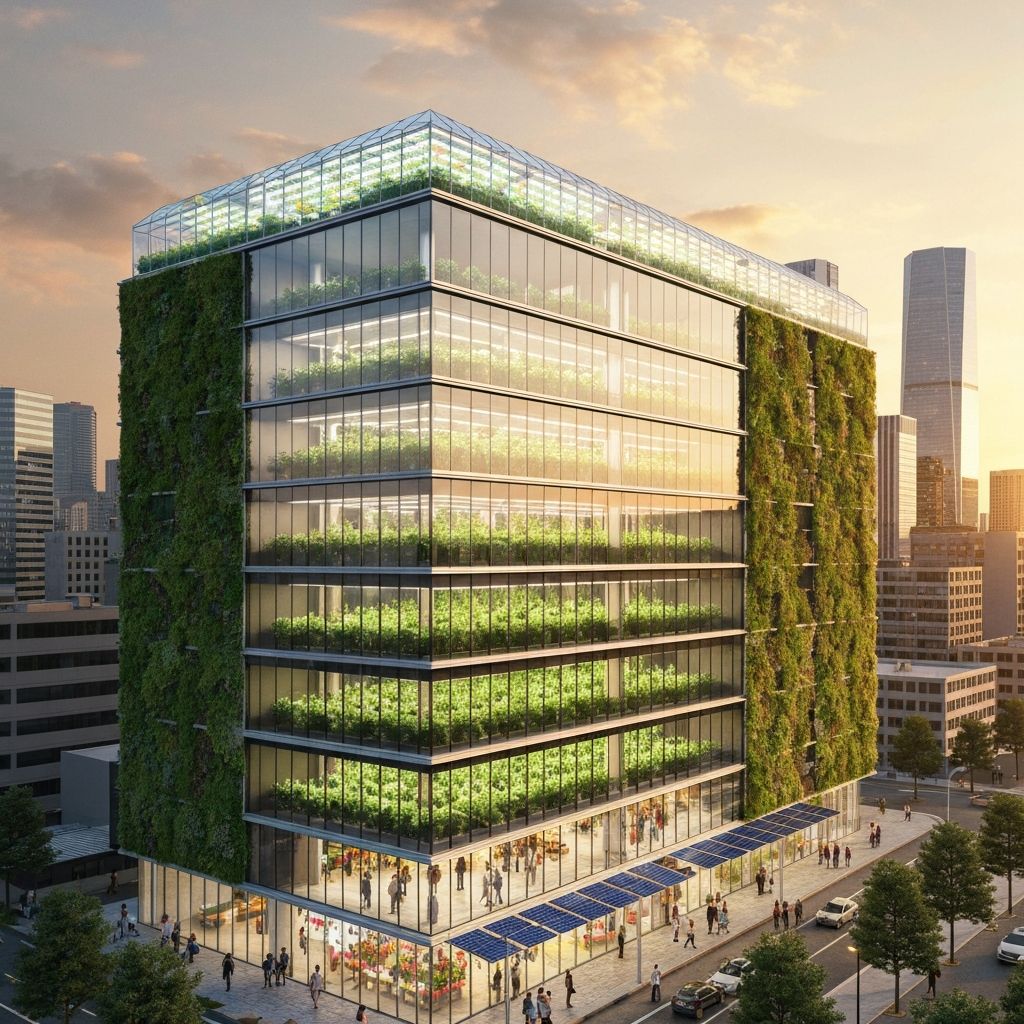
Concept visualization: Multi-story circular food ecosystem integrated into urban environment
Not Vertical Farming
AVERY is not hydroponics towers and lettuce walls. It is a complete circular food ecosystem compressed into the third dimension. The form of the building changes completely depending on context.
Three Scales of AVERY
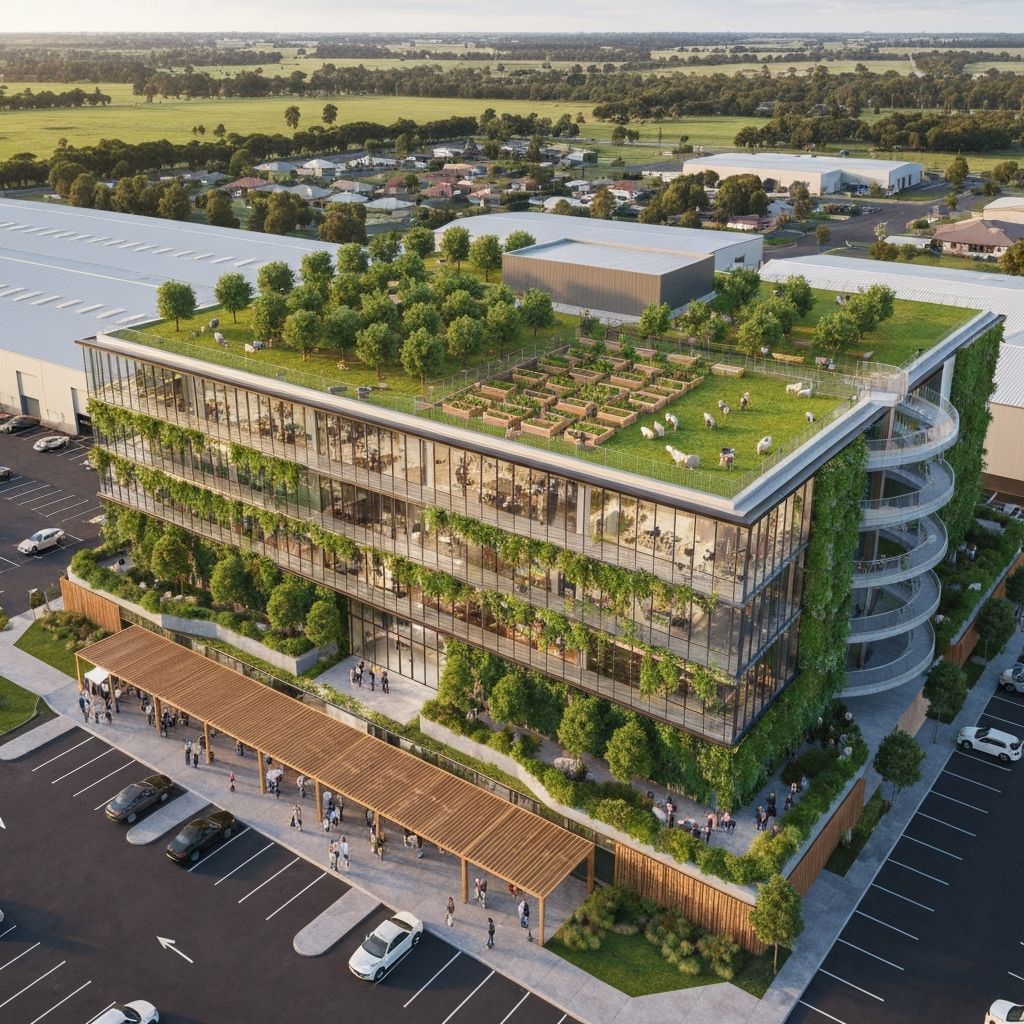
Community Food Hub
3-4 floors, Bunnings-scale footprint. Markets at ground level, rooftop grazing, positioned where suburbs meet acreage. Feeds 1,500–4,000.
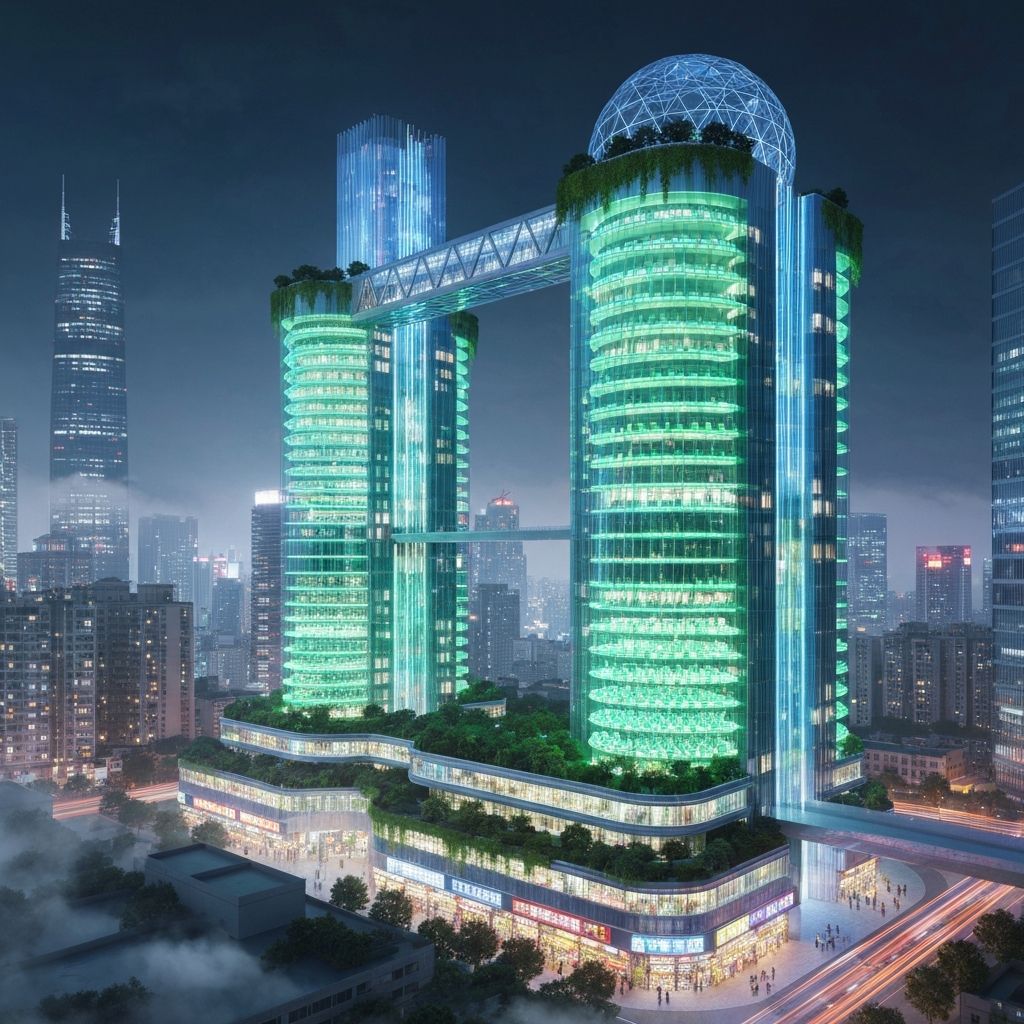
Urban Food Tower
50-70 floors for dense Asian megacities. Complete circular ecosystem in a tower. The logical endpoint at scale. Feeds 25,000–30,000.
Suburban
3–4 floors
Wide, low-rise — Bunnings or IKEA scale
Approved in commercial/industrial zones with no planning drama
City
20–40 floors
Standard commercial — Architecturally significant
Production floors visible, rooftop is a living pasture
Megacity
Up to 70 floors
Tower scale — Shanghai, Singapore
The logical endpoint of the model at scale — not being built tomorrow
What AVERY Produces
- Fresh fish (barramundi)
- Eggs
- Vegetables
- Fermented products
- Goat dairy
- Biogas energy
What AVERY Does Not Produce
- Beef — cattle belong on land, not floors
- Most fruit
- Cooking oils
- Staple carbohydrates
Red meat comes from the peri-urban land layer surrounding the city.
“Cattle belong on land, not floors.”
The Peri-Urban Cattle Belt
Grass-fed beef is the one component of the food system that cannot be compressed into a building. Cattle require real pasture. The grass-finished quality that makes beef genuinely therapeutic rather than merely edible is inseparable from the land it grows on. There is no LED substitute for 160 acres of rotating pasture.
Every Australian city is surrounded by agricultural land that is currently underperforming. Former grain monocultures with depleted topsoil. Degraded grazing land running conventional feedlot operations. Idle parcels sitting in speculation. The peri-urban cattle belt does not require new land to be created — it requires existing land, already within 20-40 kilometres of the urban boundary, to be redirected toward a higher-value use under a more intelligent management model.
Under Holistic Planned Grazing, the same 160 acres that currently produces mediocre conventional beef at subsistence margins becomes a regenerative system that simultaneously produces premium grass-finished beef, builds topsoil carbon at measurable rates, generates Australian Carbon Credit Units (ACCUs), creates a firebreak buffer of managed grassland around the urban fringe, and demonstrates measurable ecological improvement.
The surrounding rural belt of every city should be urgently earmarked as cattle and farming land — not sprawling suburbs. AVERY handles the intensive production. The land handles the cattle.
Building Cross-Section
A simplified view of how production distributes vertically. Exact configuration varies by building type and local requirements.
Living Pasture & Solar
Goat grazing, beehives, photovoltaic array
Crop Production
Vegetables, herbs, microgreens in controlled environment
Poultry & Aquaculture
Egg production, barramundi tanks, integrated aquaponics
Fermentation & Dairy
Goat dairy, cheese aging, kombucha, fermented vegetables
Market & Restaurant
Direct sales, farm-to-table dining, education centre
Biogas & Infrastructure
Anaerobic digesters, energy storage, water treatment
The Commercial Offset Model
AVERY cannot survive on food production economics alone. It needs a commercial offset — exactly like ARDEN's hotel and wellness trail fund the rural community.
Farm-to-Table Restaurant
The farm is literally above the kitchen. Peak freshness, zero food miles, complete traceability.
Wellness & Education Centre
Cooking classes, nutrition programs, school excursions, corporate wellness retreats.
Premium Daily Market
Fresh produce, eggs, fish, and fermented goods sold direct to residents and visitors.
Research Partnerships
University collaborations, government grants, industry research contracts.
Carbon Credits
Verified carbon sequestration and methane capture generate tradeable credits.
Critical insight: Councils need to design their commercial offset before their production model.
Join the Research Program
For councils, developers, and researchers who want to be positioned to build AVERY when ARDEN's evidence base is ready.
No financial commitment implied. This is research collaboration, not a sales pipeline.
The Evidence Path
ARDEN generates the evidence base that makes AVERY politically approvable. Three to five years of documented outcomes will give progressive urban councils the data they need to lead. The proof starts here. The city comes next.